High End Outdoor Furniture Buying Guide for 2026
Table of Contents
- What Sets High End Outdoor Furniture Apart
- How to Measure for Patio Furniture Before You Buy
- The Best Outdoor Furniture Materials for Your Climate
- Types of Outdoor Furniture Sets and How to Choose
- Your Outdoor Furniture Buying Checklist
- Teak Outdoor Furniture Care and Long-Term Upkeep
- Frequently Asked Questions
Last Updated: October 9, 2026
What Sets High End Outdoor Furniture Apart
High end outdoor furniture is built around a simple idea: the piece should look and feel as considered in year ten as it did on delivery day. That means solid frame construction, joinery that resists movement, and materials chosen for weather exposure rather than for a catalog photo. At The Lavish Sunset, we help homeowners think through this before they commit, because the difference between good patio furniture and a genuine long-term investment rarely shows up in the first season.

The clearest signal of quality is what you cannot see. Look underneath a dining table and check how the legs meet the apron. Check whether hardware is stainless steel rather than painted steel, and whether cushions use quick-drying foam that lets water pass through instead of trapping it.
Signs of Real Craftsmanship
A few checks separate real craftsmanship from a convincing finish:
- Joints that are mortise-and-tenon or similarly interlocking, not stapled and glued
- Stainless steel hardware throughout, including bolts and glides
- Even finish coverage on hidden surfaces, not just the visible face
- Cushion covers with removable, washable zips and performance fabric
- A frame that feels heavy and stable when you press down on one corner

How to Measure for Patio Furniture Before You Buy
Measuring is the step most buyers rush, and it is the reason so many sets end up feeling wrong once assembled. Before you shop, sketch your patio to scale and mark doors, steps, and any fixed feature you cannot move.
Leave walking clearance of roughly 36 inches (about 91 centimeters) behind pulled-out dining chairs, and about 18 inches (45 centimeters) between a coffee table and lounge seating. For dining, allow about 24 inches (61 centimeters) of table width per person. Measure your doorway and any gate the delivery team must pass through, since a sectional arrives in pieces but the largest piece still has to fit.
The Best Outdoor Furniture Materials for Your Climate
The best outdoor furniture materials are the ones matched to your local weather, not the ones with the highest price tag. Teak, aluminum, and resin wicker each handle sun, rain, and temperature swings differently, and the right answer depends on where the piece will live. Treating weather resistance as a single quality is the most common mistake buyers make, because salt air, intense UV, freeze-thaw cycles, humidity, and heavy rain each stress furniture in different ways.
Coastal Salt Air
Salt is the most aggressive everyday exposure for metal hardware. It accelerates corrosion on anything ferrous and pits lower-grade finishes over time. Marine-grade aluminum and teak both hold up well here, and stainless steel hardware is close to non-negotiable. Rinse frames and hardware with fresh water a few times a season to wash away salt film, and choose cushions in performance fabric rated for fade and mildew resistance.
Intense UV and High-Heat Sun
Sustained UV breaks down fibers, fades dyes, and dries out natural oils in wood. Teak handles UV well but will silver faster in full sun. Solution-dyed performance fabrics resist fading better than surface-dyed fabrics because the color runs through the fiber rather than sitting on top of it. Light-colored cushions stay cooler to the touch, and powder-coated aluminum frames resist heat buildup better than bare metal.
Freeze-Thaw Cycles
Water that seeps into joints, cushions, or porous surfaces and then freezes can crack finishes and loosen joinery. In cold-winter regions, choose frames with tight joinery and drainage, store cushions indoors for the off-season, and avoid leaving standing water on tabletops. Teak and powder-coated aluminum both tolerate freeze-thaw better than materials that absorb moisture.
Humidity and Heavy Rain
Constant moisture encourages mildew on cushions and rot in untreated wood. Quick-drying foam and removable, washable cushion covers matter more here than anywhere else. Teak's natural oils resist rot, and aluminum will not rust, so both are strong choices. Elevate pieces slightly off the ground so water drains rather than pooling at the base.
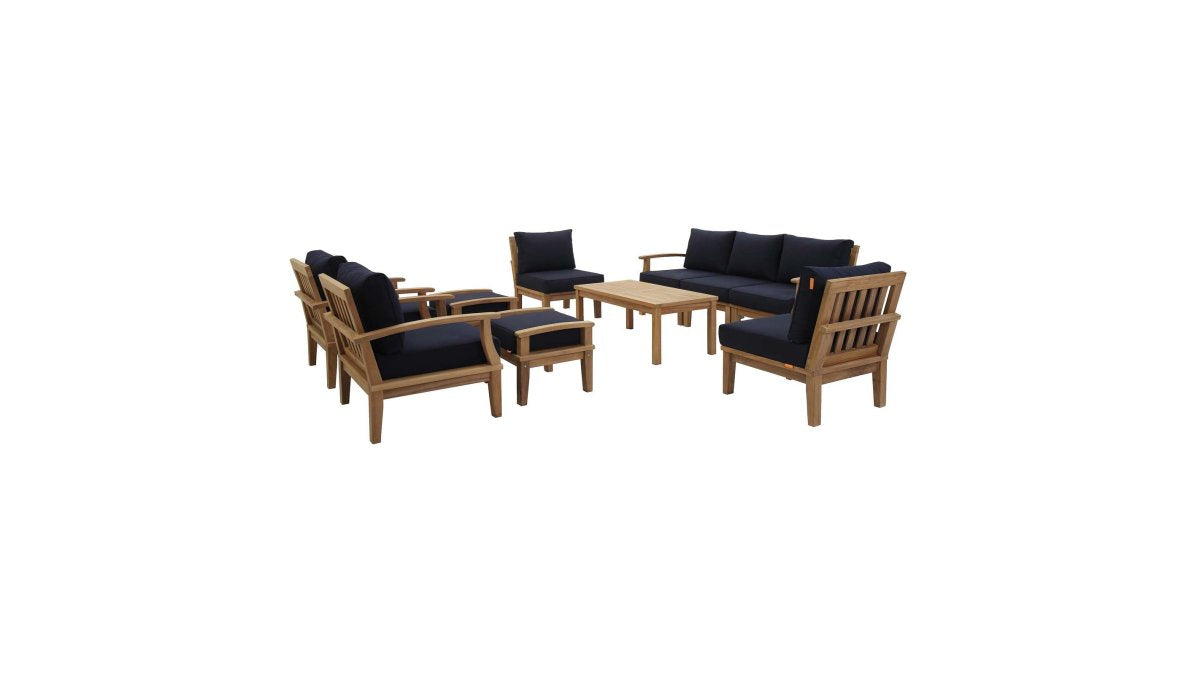
The Lavish Sunset Teak Set - Lavish Sunset Marina 10-Piece Outdoor Set →
Matching Material to Exposure
A single patio often has more than one microclimate. A covered porch is not the same as an open deck, and a west-facing wall bakes hotter than a shaded corner. It is reasonable to mix materials across a space, using teak or aluminum in the most exposed spots and resin wicker under a roof.
| Material | Best For | Watch Out For |
|---|---|---|
| Teak | Sun, rain, long lifespan, most climates | Needs periodic cleaning to stay golden |
| Marine-grade aluminum | Coastal and humid air | Can feel hot in direct sun |
| Resin wicker | Covered patios, low upkeep | Frame quality varies widely |
| Performance fabric | Cushions and upholstery | Cheaper versions fade faster |
If you want to go deeper, the U.S. Forest Service guidance on wood durability and decay resistance explains why dense hardwoods hold up outdoors, and the FTC guidance on environmental marketing claims is worth reading before you pay more for a sustainability label.
Types of Outdoor Furniture Sets and How to Choose
Choosing a set starts with how you actually use the space, then narrows by dimensions, seating capacity, and how flexible you want the layout to be. A household that hosts dinners needs a dining set with an extendable table. A household that unwinds in the evening needs lounge seating and a sectional. Many homes need a little of both.

Start With the Layout, Not the Set
Sketch your patio to scale and mark doors, steps, and fixed features you cannot move. Then block out zones: a dining zone, a lounge zone, and a circulation path between them. A set that looks generous in a showroom can overwhelm a narrow patio once chairs are pulled out.
Seating Capacity Math
For dining, allow about 24 inches (61 centimeters) of table width per person, and roughly 36 inches (about 91 centimeters) of clearance behind pulled-out chairs. For lounge seating, plan on about 18 inches (45 centimeters) between a coffee table and the sofa or chairs. These numbers tell you how many people a space can genuinely seat, not just how many the set claims to hold.
Dining Sets
Dining sets anchor a patio and define the gathering zone. Extendable tables are the most forgiving choice because they seat a small group day to day and open up for holidays. Look for tables with a stable apron and legs positioned so they do not crowd knees.
Lounge Seating and Sectionals
Lounge seating and sectionals suit conversation and quiet evenings. A sectional maximizes seating along walls and corners, while separate lounge chairs let you rearrange and add pieces over time. Measure the largest single piece against your narrowest delivery path, not just the final footprint.
Modular and Flexible Configurations
Modular designs are the most forgiving, because you can add or reposition pieces as your needs change. They also make it easier to adapt a space seasonally, shifting a chaise into the sun and pulling seating into a conversation circle.
Filling the Gaps
Side tables, lounge chairs, and accent pieces fill the gaps and let you rearrange over time. A side table beside every seat, a coffee table at the center of the lounge zone, and a small console near the door make a space feel finished rather than furnished.
For a set that covers both dining and lounging, our Lavish Sunset Marina 10-Piece Outdoor Set with Navy Cushions pairs premium-grade teak with navy cushions and seats a large group. If your space is tighter or you prefer a sectional layout, the Lavish Sunset Marina 8-Piece Outdoor Teak Sectional Set adapts to different arrangements. For dining specifically, the Julien FSC Certified Teak Wood Outdoor Patio Extendable Dining Set extends to seat extra guests.
The Lavish Sunset Teak Set - Lavish Sunset Marina 10-Piece Outdoor Set →

Your Outdoor Furniture Buying Checklist
An outdoor furniture buying checklist keeps a large purchase from turning into a series of guesses. Work through it in order, and you will avoid the mismatched-result problem that stalls so many backyard projects.
- Measured the patio, delivery path, and doorways
- Confirmed the material suits your climate
- Checked frame joinery and stainless steel hardware
- Verified cushions use performance fabric and quick-drying foam
- Confirmed the set size matches how you actually host
- Asked about lead times, delivery, and assembly
- Reviewed the return policy and warranty terms
- Planned storage or protective covers for the off-season
Teak Outdoor Furniture Care and Long-Term Upkeep
Teak outdoor furniture care is simpler than most people expect, and doing less is often better than doing too much. Teak contains natural oils that resist moisture and insects, so it does not need sealing to survive the elements.
Clean teak once or twice a year with mild soap, warm water, and a soft brush, then rinse and let it dry. If you prefer the original golden tone, a teak cleaner and brightener will restore it; if you like the silver-gray patina, simply leave it. Avoid pressure washing, which raises the grain. For cushions, brush off debris, spot clean with mild soap, and store them dry. Protective covers extend the life of every piece, and a little attention at the end of each season goes a long way.
A beautiful outdoor space should feel effortless once it is finished, and the decisions that get you there are easier with guidance than guesswork. The Lavish Sunset offers a curated collection of premium outdoor furniture and a personalized luxury concierge service to help you match pieces to your space, your climate, and the way you actually live outside. Explore our outdoor furniture collection or contact our luxury concierge for personalized guidance, and let us help you create a retreat worth staying home for.
Frequently Asked Questions
What should I look for when buying high-end outdoor furniture?
Start with the frame. Premium pieces use solid teak, powder-coated aluminum, or resin wicker over a metal core, joined with stainless steel hardware that resists rust. Check the cushion fabric for fade and water resistance, and confirm the set fits your patio with at least 3 feet of walkway clearance. A written warranty and a clear return policy matter just as much as the finish.
Is aluminum or teak better for outdoor furniture?
Both perform well, but they suit different spaces. Aluminum frames are light, rust-resistant, and easy to rearrange, which helps on balconies and in coastal humidity. Teak is denser, naturally weather-resistant, and ages into a soft silver-gray if left untreated. For a permanent dining or lounge arrangement in a sunny yard, teak often holds its structure longer.
How do I choose outdoor furniture that will last?
Look for full-length frame construction rather than hollow tubing, stainless steel hardware, and cushions with quick-drying foam and performance fabric. Ask how the finish handles UV exposure, and plan for seasonal care. Storing cushions and using protective covers during harsh weather extends the life of any set, including the best outdoor furniture materials on the market.
How should I care for outdoor cushions?
Brush off debris weekly and spot clean with mild soap and water, then let cushions air dry fully before stacking them. Bring them inside or into a storage box during heavy rain and winter months. Performance fabric resists fading and moisture, but no cushion lasts as long when it sits outside year-round. Quick-drying foam helps, yet airflow is still the key.
How do I choose the right size patio furniture?
Measure your patio first, then subtract clearances. Plan roughly 3 feet between seating and walkways, and about 2 feet between a dining chair and the table edge so guests can slide in comfortably. A sectional sofa needs more depth than a lounge chair, so sketch the layout on paper before ordering. When in doubt, choose a slightly smaller set.